
The Flip-side of Video Games
- Srishti Bajoria

- Mar 13, 2021
- 4 min read
Bereft of any concept of time, dark room, slouched shoulders, glaring eyes with a single reflection of the screen. It is a dark night. You just escaped from the mission, and you are terrified. You have been shot and stabbed as you try to escape this life-or-death situation. You leave a pixelated trail of red as you have your last life remaining. At that moment, you hear your most dreaded sound and the words pop-up on your screen – ‘game over.’

Source: https://wallha.com/wallpaper/glitch-art-artwork-game-over-688312
With the advancements in technologies and increased exposure, individuals of all ages are subjected to influences from external entertainment sources. Year by year, there is a drastic increase in gaming platforms and new video games’ creations due to popular demand. Along with the console industry’s growth, popular media platforms such as social media and pop-culture have also noticed a drastic increase. Imagine a stereotypical household in which young boys and girls are glued to their screens from morning-to-night. Parents recite the continuous dialogue, “In our times we did not have screens, we went out to play”, only to receive nonchalant responses, repeating this same cycle each passing day. However, is this argument always valid? Do all video-games truly harm children?
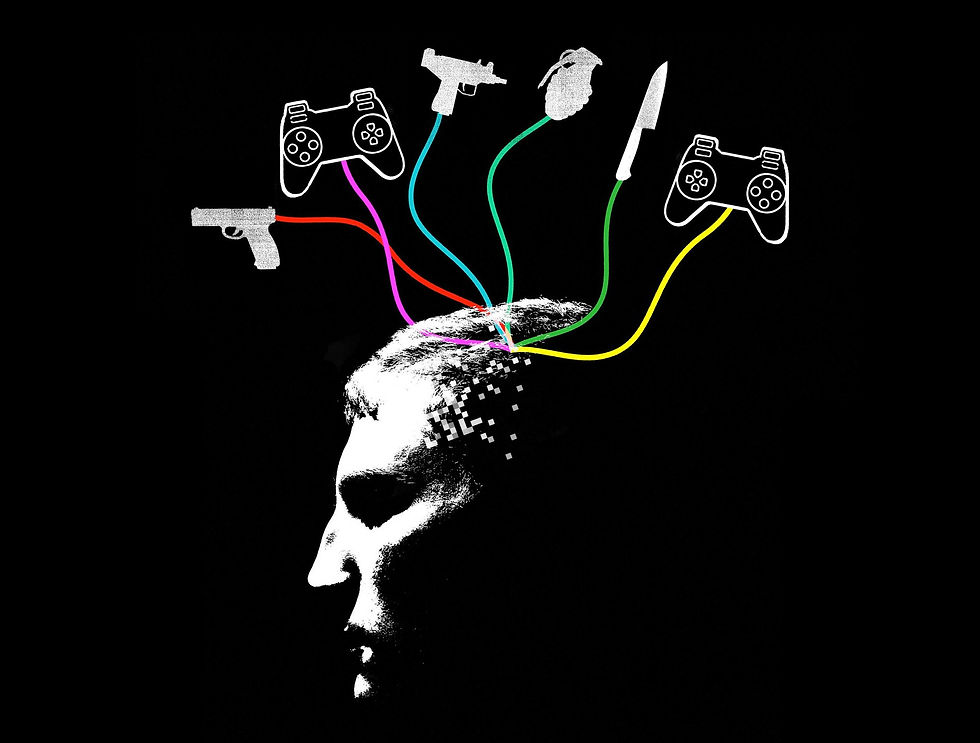
Video-games and animation can portray all kinds of content, which may negatively impact the impressionable minds of young individuals. One such portrayal of popular media is that of violence. Through video-games, young children create their personal avatars and use this during ‘war games’ or ‘shooting games’ primarily aiming to kill and injure as many people as possible. This can lead to children internalizing these feelings and severely impacting thought processes and behaviours. Games such as ‘Grand Theft Auto’ (GTA) promotes intense violence, strong sexual content and, endless blood and gore. The game is recommended for ages 13 and above. Simultaneously, the use of inappropriate language and visuals leaves an impression on a teenager’s malleable brain. With GTA being one of the universal highly-demanded video games, are these the virtual role models we want our future generations to look up to?
Source: https://www.nytimes.com/2013/02/12/science/studying-the-effects-of-playing-violent-video-games.html
Research suggests the relations between video-gaming habits and psychological functioning. One such relation states that video-games have strong addictive qualities and can lead to low self-esteem and social skills. Excessive gaming has caused ‘Internet Gaming Disorder’ to be recognized by the American Psychiatric Association (APA) as having addictive tendencies similar to gambling. This suggests the seriousness and negative consequences of video-gaming, such as lower psychosocial well-being, loneliness, and low self-efficacy. Along with this, there exists a multitude of evidence to suggest the relationship between violent video-games and aggressive tendencies in children. As animations becoming more realistic each passing year, virtual violence becomes even more brutal. It may not be in our hands to ban violent video games such as ‘GTA’ or ‘Sniper Elite’. However, discouraging the use and distribution of these on impressionable young minds proves to be imperative.

Source: https://www.indiatoday.in/lifestyle/health/story/according-to-american-psychological-association-report-violent-video-games-trigger-aggression-288533-2015-08-16
On the one hand, video-games have been portrayed as an ‘evil robotic machine which takes an overall sense of reality. On the other hand, certain video-games also have positive effects on children. These have been proven to enhance executive functioning by increasing an individual’s problem-solving abilities, attention and, motivation. One of the greatest benefits of video-games is that it has proven to be ‘cathartic’. Children who face difficulties at school or home find themselves removing this frustration by immersing themselves in the online fictional world without causing any physical or verbal harm in real life.
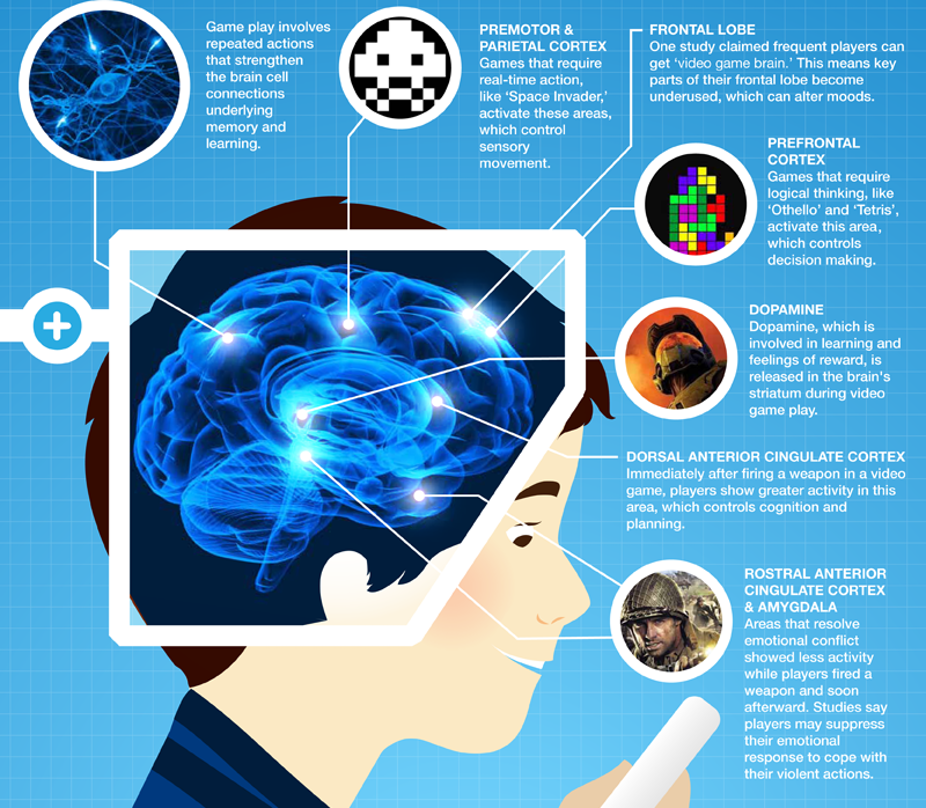
Parents primarily view video-games as potentially harmful and dangerous for a growing child. However, being banned from playing these games makes children feel left out. This common dispute is echoed in several houses between parents and teenagers, causing feelings of resentment and misunderstanding. Balance is vital. Instead of banning video games, parents can discourage violent games and allow those that increase a child’s creativity and problem-solving abilities. Studies show that several action games such as ‘Super Mario’ have positive benefits for players and challenges the brain. Research conducted in the field proved that the group of children who were made to play Super Mario had a ‘volumetric brain increase’. Significant improvements in the prefrontal cortex region were found since the game required individuals to plan ahead, along with an increase in the right hippocampus and cerebellum-motor skills. Another such video-game, ‘Minecraft’ has been programmed to serve high entertainment value and enhance life skills. Children are transported into this virtual animated world created out of ‘pixels’. They are made to exercise creativity in a limitless manner by building their online sci-fi world. The ‘survival mode’ in the game teaches children problem-solving abilities. The very nature of the program promotes a balance between collaboration and independence. Suppose parents were to promote video-games such as these. In that case, children will develop an increased imagination and better hand-eye coordination. Such logic-based games enable young minds to formulate strategies at an early age, leading to a broadened horizon and scope for the future.
Source: https://theconversation.com/playing-video-games-is-good-for-your-brain-heres-how-34034
Video-games prove to be some of the most substantial evidence of technological advancement and creativity. The same statement used by older generations, “we never had it in our days”, shows the immense technological progress our world has made. Certain games are potentially harmful. However, there is a repertoire of video-games that expand the child’s creativity. As a society, we must divert our focus onto the educational tools and reap the benefits that technology has provided us with instead of making it a product of the ‘generational gap’. Today, put your step forward and empathize with your child. Take the initiative to create your virtual avatar and be open to new experiences and learning. Be it learning how to build cities in ‘Minecraft’, teamwork in multiplayer games, or listening to your intuition in ‘Among Us’. All video-games are not harmful, and with a bit of understanding and encouragement, our future generations can build a whole new dimension. Today’s youth can pave the way to using the most advanced coding techniques and AI technologies in making the world a safer and better place to live in.


Comments